Organic Chemistry I · Lesson 04
Acids and Bases
Acid-base chemistry is everywhere in organic reactions. Predicting which molecule is more acidic, and why, is one of the most useful skills in the entire course. The framework that makes this predictable is called ARIO.
Learning Goals
- Define Brønsted-Lowry and Lewis acids and bases.
- Explain why organic chemists rely on Lewis acid-base theory.
- Use ARIO (Atom, Resonance, Induction, Orbital) to predict relative acidity.
- Explain why resonance stabilization of the conjugate base increases acid strength.
- Identify conjugate acid-base pairs in a reaction.
- Rank a series of molecules by acidity or basicity using structural reasoning.
Section 1
What Is an Acid? What Is a Base?
There are two definitions used constantly in organic chemistry. They overlap but are not identical.
Brønsted-Lowry
An acid donates a proton (H⁺). A base accepts a proton. This is the definition you likely learned first, and it works well for reactions that move a hydrogen from one molecule to another.
Lewis
An acid accepts an electron pair. A base donates an electron pair. This definition is broader. It includes reactions with no proton involved at all, like a carbocation accepting electrons from a nucleophile.
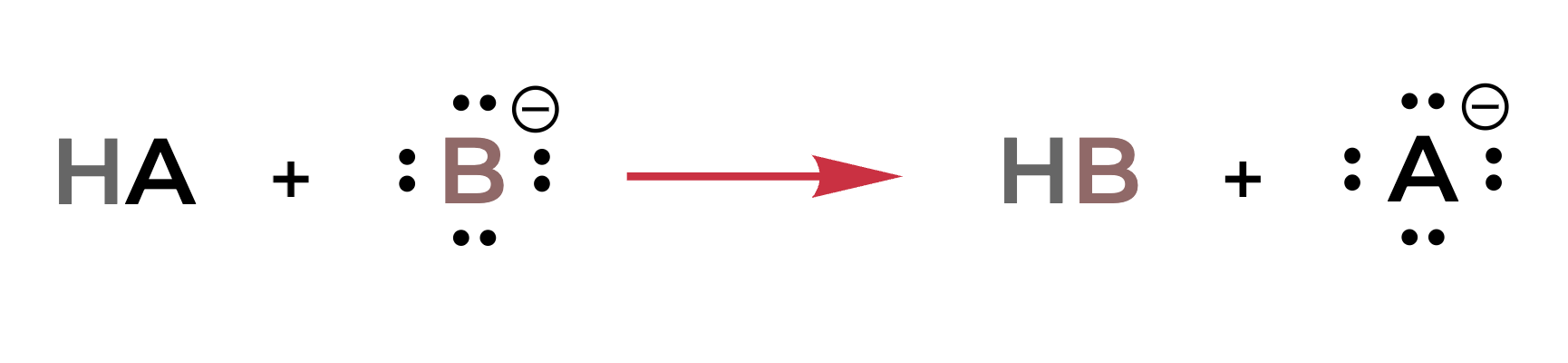
Brønsted-Lowry: proton transfer
Section 2
Why Organic Chemistry Relies on Lewis Acid-Base Theory
Almost every mechanism you will draw this year is, at its core, a Lewis acid reacting with a Lewis base. A nucleophile attacking an electrophile is electron pair donation and acceptance. A carbocation being attacked by a nucleophile is the same idea, since no proton needs to move at all.
Here is the connection I want you to make early: Brønsted-Lowry theory is really just a special case of Lewis theory, the case where the electron pair acceptor happens to be a proton. Once you start thinking in terms of electron pair movement, mechanisms across the entire course (substitution, elimination, addition, and everything else) start to look like the same basic event repeating with different atoms involved.
Main idea
Every curved arrow you have drawn so far, in resonance or in mechanisms, is electron pair movement. That's what makes Lewis acid-base theory the underlying principle of the entire course.
Section 3
Measuring Acid Strength: pKa
pKa measures how easily a molecule gives up a proton. The lower the pKa, the stronger the acid. This is a log scale, so a difference of 1 unit means a 10-fold difference in acid strength.
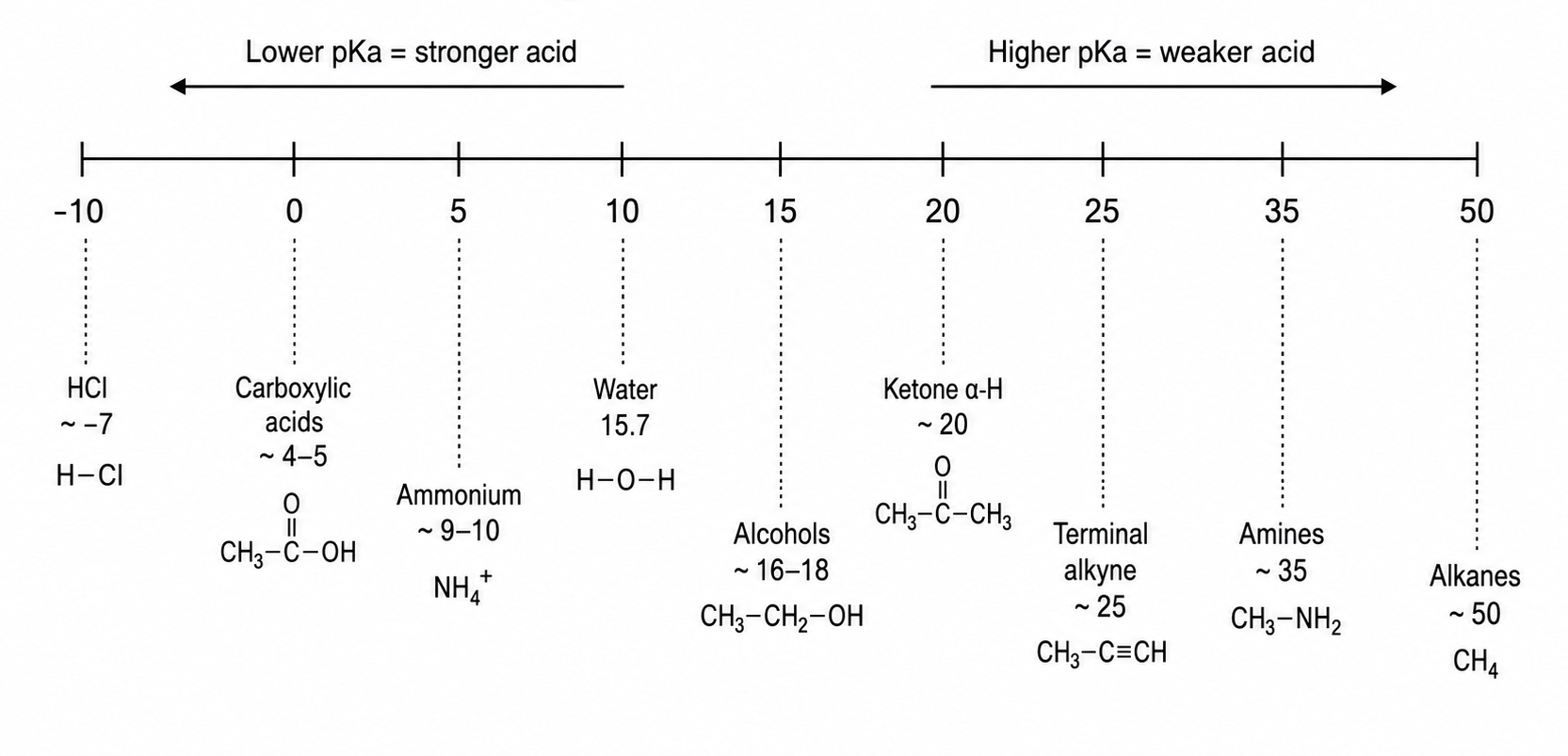
Lower pKa = stronger acid
Key relationship
Here is the main link: a stronger acid has a more stable conjugate base. If you can explain why the conjugate base is stable, you can explain why the acid is strong, and that is exactly what ARIO is built to do.
Section 4
ARIO: Atom, Resonance, Induction, Orbital
ARIO is the framework I use to predict and explain relative acidity without memorizing pKa values. Every time you compare two acids, walk through these four questions in order.
Atom
Going down a column on the periodic table, acidity increases. Larger atoms hold negative charge more comfortably because the charge is spread over a bigger, more polarizable volume. This is why thiols (S-H) are more acidic than alcohols (O-H), even though oxygen is more electronegative. Atom is the single most powerful factor in ARIO.

Atom
Rule
Down a column: acidity increases because of increasing size. Across a row: acidity increases because of increasing electronegativity.
Resonance
If the negative charge on the conjugate base can be delocalized through resonance, the conjugate base is more stable, and the acid is stronger. A carboxylic acid is far more acidic than an alcohol because its conjugate base (carboxylate) spreads the negative charge over two oxygens.
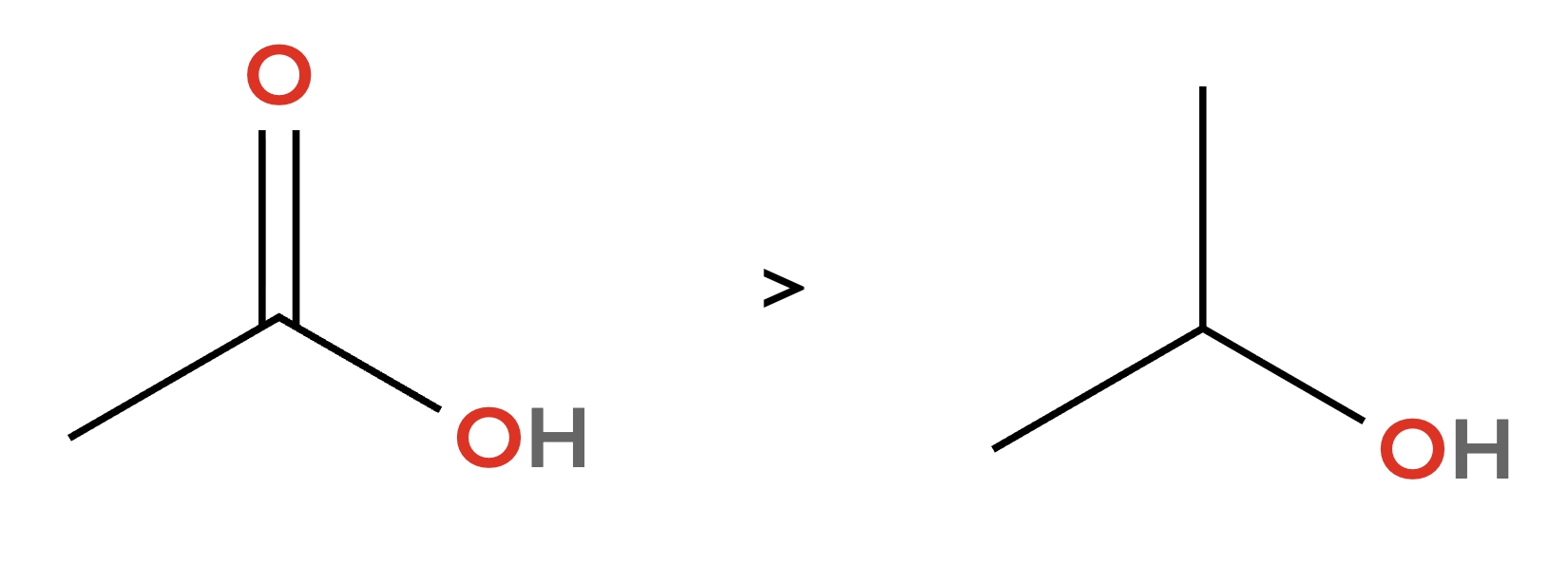
Resonance
Rule
More resonance structures stabilizing the conjugate base = stronger acid.
Induction
Electronegative atoms are electron WITHDRAWING groups, so they can pull electron density away through the sigma bond network and stabilize the negative charge on the conjugate base. This effect weakens with distance. Chloroacetic acid is more acidic than acetic acid because the chlorine inductively withdraws electron density and stabilizes the carboxylate.
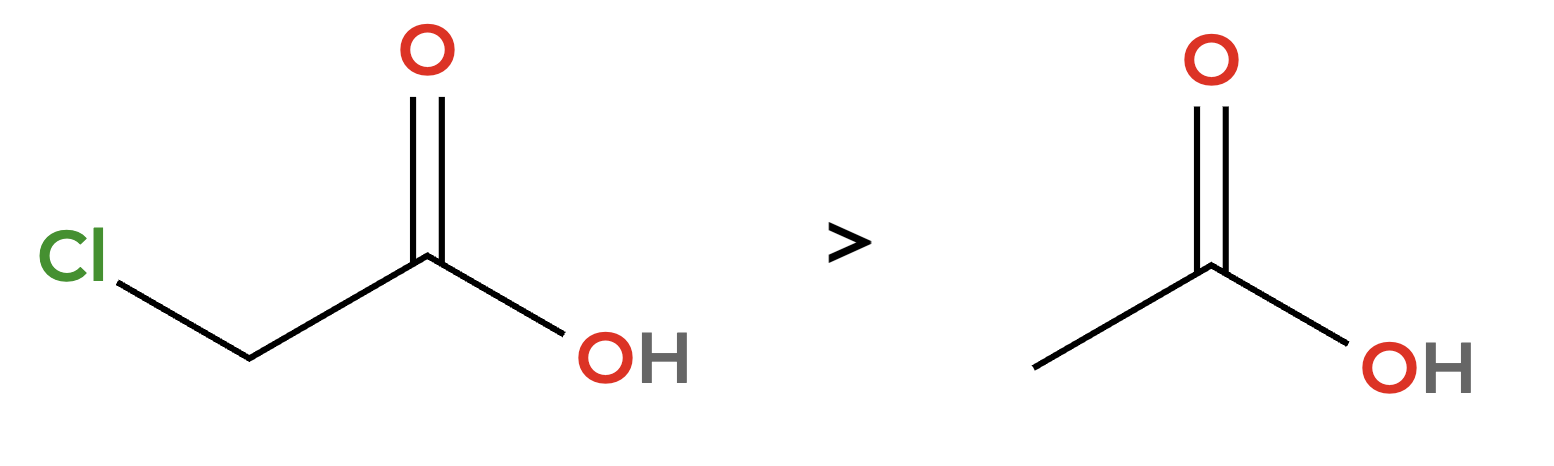
Induction
Rule
Nearby electronegative atoms increase acidity. The effect drops off quickly with distance.
Orbital
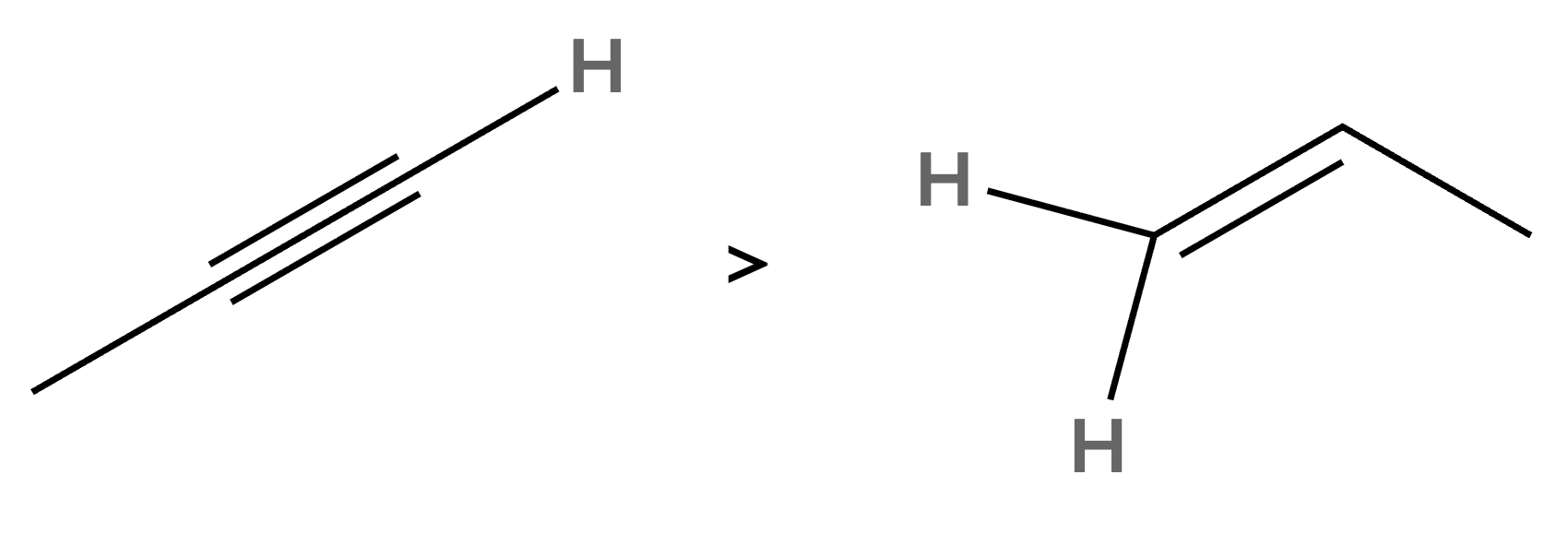
More s-character in the orbital holding the negative charge means the electrons sit closer to the positive nucleus, which is more stable. sp orbitals are 50% s-character, sp2 are 33%, and sp3 are 25%. This is why a terminal alkyne C-H is far more acidic than an alkene or alkane C-H.
Orbital
Rule
More s-character (sp > sp2 > sp3) = more stable conjugate base = stronger acid.
Priority order when factors conflict
- 1.Atom identity matters most. Compare whether the atom is bigger or more electronegative based off the row or column.
- 2.If atom is the same, then resonance is next.
- 3.Induction matters next, especially with strongly electronegative atoms nearby.
- 4.Orbital hybridization matters most when comparing C-H bonds specifically.
Section 5
Why Atom Matters Most
Of the four ARIO factors, atom identity is the first and most important comparison I want you making. Before you check resonance, induction, or orbital hybridization, ask one basic question: which atom will hold the negative charge after the proton leaves?
The conjugate base is stronger or weaker depending heavily on the atom carrying the negative charge. A larger atom can spread charge over more space, making that charge easier to tolerate. This is why acidity increases as you move down a column of the periodic table. Sulfur can stabilize negative charge better than oxygen because sulfur is larger and more polarizable, even though oxygen is more electronegative.
Atom factor: larger atoms stabilize negative charge better down a column
This is why thiols are more acidic than alcohols. An alcohol loses H⁺ to form an alkoxide, where the negative charge is on oxygen. A thiol loses H⁺ to form a thiolate, where the negative charge is on sulfur. Since sulfur is larger than oxygen, the thiolate conjugate base is more stable, so the thiol is more acidic.
Tip
A naming shortcut I lean on: names ending in -ate usually refer to negative ions like nitrate, NO₃⁻, or sulfate, SO₄²⁻, while names ending in -ium usually refer to positive ions like ammonium, NH₄⁺, or hydronium, H₃O⁺.
Section 6
Common Mistakes
Practice Set
Try each question before opening the answer.
1. What is a Brønsted-Lowry acid?
Answer: A proton (H⁺) donor. A Brønsted-Lowry base is a proton acceptor.
2. What is a Lewis acid?
Answer: An electron pair acceptor. A Lewis base is an electron pair donor. This definition is broader than Brønsted-Lowry and includes species without an acidic proton, like BF₃.
3. Why do organic chemists prefer Lewis acid-base theory over Brønsted-Lowry alone?
Answer: Many important organic reactions involve electron pair donation and acceptance without an actual proton transfer, such as carbocation formation or nucleophilic attack. Lewis theory covers these cases.
4. Rank these by acidity: ethanol, acetic acid, chloroacetic acid.
Answer: Chloroacetic acid > acetic acid > ethanol. Acetic acid beats ethanol due to resonance in the carboxylate. Chloroacetic acid beats acetic acid due to added induction from chlorine.
5. Why is a thiol (R-SH) more acidic than an alcohol (R-OH)?
Answer: Sulfur is larger and more polarizable than oxygen. Even though oxygen is more electronegative, the larger size of sulfur stabilizes the negative charge on the conjugate base more effectively. This is the Atom factor in ARIO.
6. Why is a terminal alkyne proton (sp carbon) more acidic than a vinyl proton (sp2 carbon)?
Answer: The sp orbital has more s-character (50%) than the sp2 orbital (33%). Electrons in orbitals with more s-character are held closer to the nucleus, which stabilizes the negative charge on the conjugate base.
7. If a conjugate base has more resonance structures, is the original acid stronger or weaker?
Answer: Stronger. More resonance structures delocalize and stabilize the negative charge, making the conjugate base more stable and easier to form, which makes the acid stronger.
8. Does the inductive effect get stronger or weaker as the electronegative atom moves farther from the acidic proton?
Answer: Weaker. Induction works through sigma bonds and decreases significantly with each additional bond of distance.
Ready for a bigger set?
Work through the full Acids and Bases practice page, including ARIO ranking exercises, conjugate base identification, and pKa comparison problems.
Do Acids and Bases PracticeLesson Summary
Acids donate protons or accept electron pairs, depending on which definition you use. Lewis theory is the broader and more useful framework for organic mechanisms. Acid strength comes down to how stable the conjugate base is, and ARIO gives you four factors to evaluate that stability: Atom, Resonance, Induction, and Orbital. Atom usually has the largest effect, regardless of any other factor. Get ARIO down and you can predict relative acidity for almost any pair of organic molecules without memorizing a single pKa value.