Alkanes and Conformations · Practice Workbook
Alkanes and Conformations Practice Questions
Fifteen questions across three skills: drawing Newman projections from line-angle structures, ranking conformer stability by strain, and working with cyclohexane chairs, ring flips, and 1,3-diaxial strain. Try each one before checking the answer.
Part A
Draw the Newman Projection
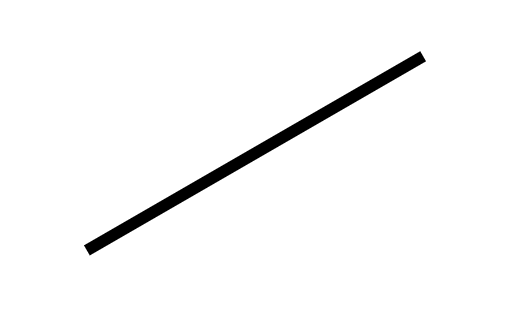
Looking down the C-C bond of ethane, draw the staggered Newman projection. Remember the dot is the front carbon and the circle is the back carbon.
Show answer

The front carbon's three C-H bonds come off the central dot, and the back carbon's three come off the circle. In the staggered form the back bonds sit exactly between the front bonds, 60 degrees apart. This minimizes torsional strain and is the lowest energy conformation.
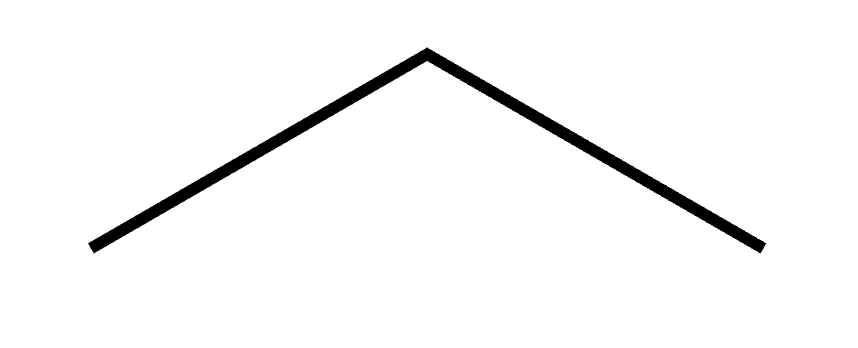
Draw the Newman projection of propane looking down the C1-C2 bond in its most stable conformation.
Show answer

Front carbon (C1) carries two hydrogens and one CH3off the dot. Back carbon (C2) carries three hydrogens off the circle. The most stable conformation is staggered, and the methyl can be in any position in this case
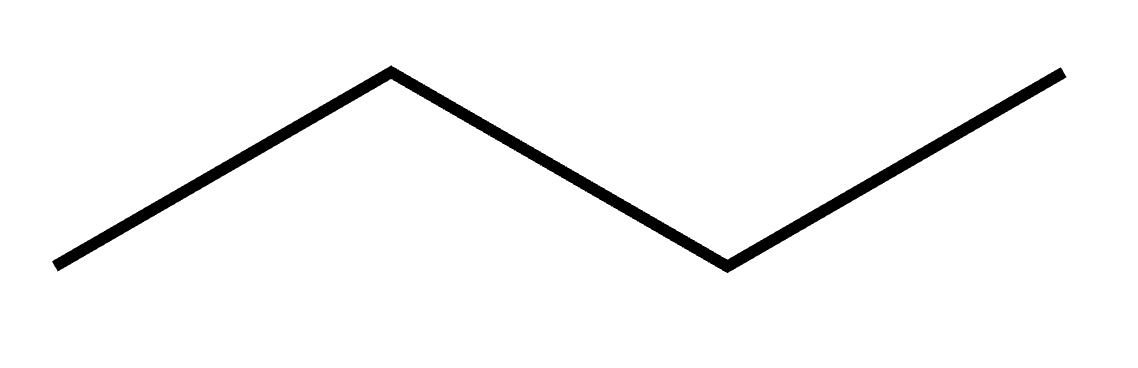
Draw the Newman projection of butane looking down the C2-C3 bond in its anti conformation.
Show answer

Looking down C2-C3, each carbon carries one CH3 and two H. In the anti conformation the front methyl points straight up and the back methyl points straight down, placing them 180 degrees apart. This is the most stable butane conformation because the bulky methyls are as far apart as possible.
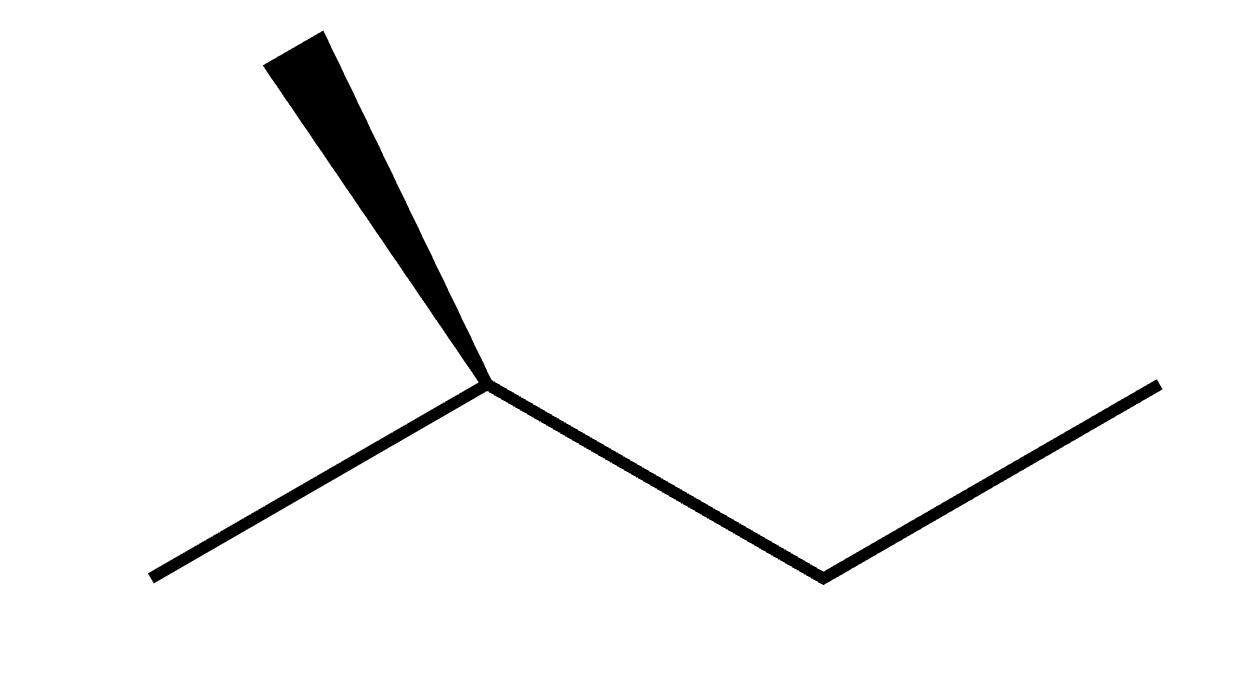
Draw the Newman projection of 2-methylbutane looking down the C2-C3 bond, then identify its most stable conformation.
Show answer

Front carbon (C2) carries two methyl groups and one H. Back carbon (C3) carries one methyl, one H, and one H (with the rest of the chain). The most stable staggered arrangement places the two largest groups anti to each other to minimize steric strain, and keeps everything else staggered.
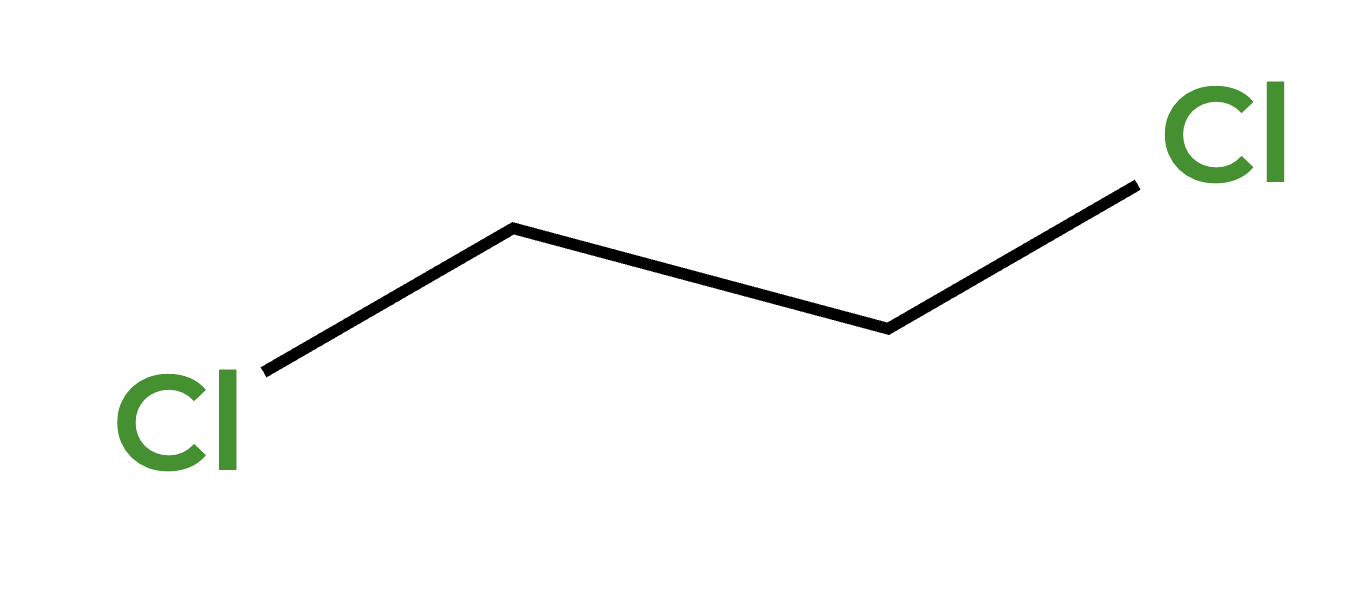
Draw the Newman projection of 1,2-dichloroethane looking down the C-C bond, placing the two chlorines in the most stable conformaiton.
Show answer

Each carbon carries one Cl and two H. Placing the two chlorines anti (180 degrees apart) keeps these two large, mutually repelling atoms as far apart as possible, giving the most stable staggered conformation. A gauche arrangement would push the chlorines to 60 degrees apart and raise the energy.
Part B
Rank and Compare Conformations
Four Newman projections of butane (down C2-C3) are shown. Rank them from most to least stable.

Show answer
Anti > gauche > eclipsed CH3/H > fully eclipsed CH3/CH3.
Anti has the methyls 180 degrees apart with no eclipsing, so it is most stable. Gauche is still staggered but the methyls are only 60 degrees apart, adding some steric strain. Both eclipsed forms have torsional strain, and the fully eclipsed CH3/CH3 also has maximum steric strain from the two methyls overlapping, making it the least stable.
Two Newman projections of ethane are shown. Which is more stable, and what type of strain causes the difference?

Show answer
The staggered conformation is more stable. The difference is caused by torsional strain, not steric strain.
Ethane has only hydrogens, so there is no real physical crowding between atoms. The eclipsed form is higher in energy purely because of torsional strain, the electron-electron repulsion between C-H bonds that line up directly across the bond axis.
A single Newman projection of butane is shown with the two methyl groups 60 degrees apart and staggered. Name this conformation.

Show answer
Gauche. The methyls are staggered (60 degrees apart) rather than eclipsed, but they are close enough to experience some steric strain.
Do not confuse gauche with eclipsed. Gauche is still a staggered conformation. The giveaway is that the bonds are offset (not lined up) but the two large groups are only 60 degrees apart instead of the maximum 180 degrees of anti.
Butane is shown in both its gauche and anti conformations. Which is lower in energy, and roughly why?

Show answer
Anti is lower in energy. In anti the methyls are 180 degrees apart, the maximum possible separation. In gauche they are only 60 degrees apart, creating steric strain from the nearby methyl groups.
Both are staggered, so neither has torsional strain from eclipsing. The difference is entirely steric: anti spreads the bulky groups far apart, while gauche brings them close enough to repel each other.
A conformation is shown where two bulky groups line up directly across the bond axis. Name both types of strain present and state which dominates.

Show answer
Both torsional strain (from the eclipsing bonds) and steric strain (from the two bulky groups crowding each other) are present. In a fully eclipsed bulky-bulky arrangement, both are maximized, making it the least stable conformation.
Eclipsing always causes torsional strain. When the eclipsing groups are also large, steric strain stacks on top. This is exactly why fully eclipsed CH3/CH3 is worse than eclipsed CH3/H: same torsional penalty, but far more steric crowding.
Part C
Cyclohexane Chairs and Ring Flips
A cyclohexane chair is shown with one bond highlighted at a single carbon. Is the highlighted bond axial or equatorial?

Show answer
Axial. The highlighted bond points roughly straight up or down, parallel to the ring's vertical axis. Equatorial bonds instead point outward along the ring's equator.
Axial bonds alternate up, down, up, down around the ring and run nearly parallel to the central axis. Equatorial bonds angle outward, roughly in the plane of the ring. Tracing one carbon at a time is the safest way to assign them.
A substituent is axial and pointing up on one chair. After a ring flip, what are its new axial/equatorial character and its up/down face?

Show answer
After the flip it becomes equatorial, but it still points up. The ring flip swaps axial and equatorial, yet a substituent's up/down face never changes.
This is the single most tested ring-flip fact. Axial becomes equatorial and equatorial becomes axial, but up stays up and down stays down. The face is fixed by the molecule's connectivity; only the axial/equatorial character toggles.
Methylcyclohexane is shown in both chair conformations, one with methyl axial and one with methyl equatorial. Which is more stable and why?

Show answer
The chair with methyl equatorial is more stable. An axial methyl suffers 1,3-diaxial interactions with the axial hydrogens two carbons away on each side, while the equatorial position points outward and avoids that strain.
At equilibrium about 95% of methylcyclohexane molecules sit in the equatorial chair. The general rule: put the largest group equatorial to avoid 1,3-diaxial strain.
cis- and trans-1,4-dimethylcyclohexane are shown. For each, can both methyl groups be equatorial at the same time?

Show answer
For the trans isomer, yes: both methyls can be equatorial at the same time, giving a very stable chair. For the cis isomer, no: one methyl is always axial and one is always equatorial, no matter which chair you draw.
For a 1,4-disubstituted ring, trans lets both groups go equatorial (the lowest strain arrangement), while cis forces one axial and one equatorial in every chair. Always check the relative positions and cis/trans relationship before deciding, rather than assuming both groups can always be equatorial.
A chair is drawn with a bulky group in the axial position. Identify which hydrogens it clashes with and name the interaction.

Show answer
The axial group clashes with the axial hydrogens on the carbons two positions away on each side (positions 3 and 5 relative to the group at position 1). This is a 1,3-diaxial interaction, a form of steric strain.
1,3-diaxial interactions are not between adjacent carbons. They involve the axial substituent and the two axial hydrogens pointing the same direction two carbons away on either side. The bigger the axial group, the stronger this strain, which is exactly why bulky groups strongly prefer equatorial.
Summary checkpoint
Ready to move on?
You are ready for Stereochemistry when you can draw a Newman projection from a line-angle structure, rank conformers by torsional and steric strain without hesitation, and find the most stable chair for a substituted cyclohexane on sight.
Go to Stereochemistry